
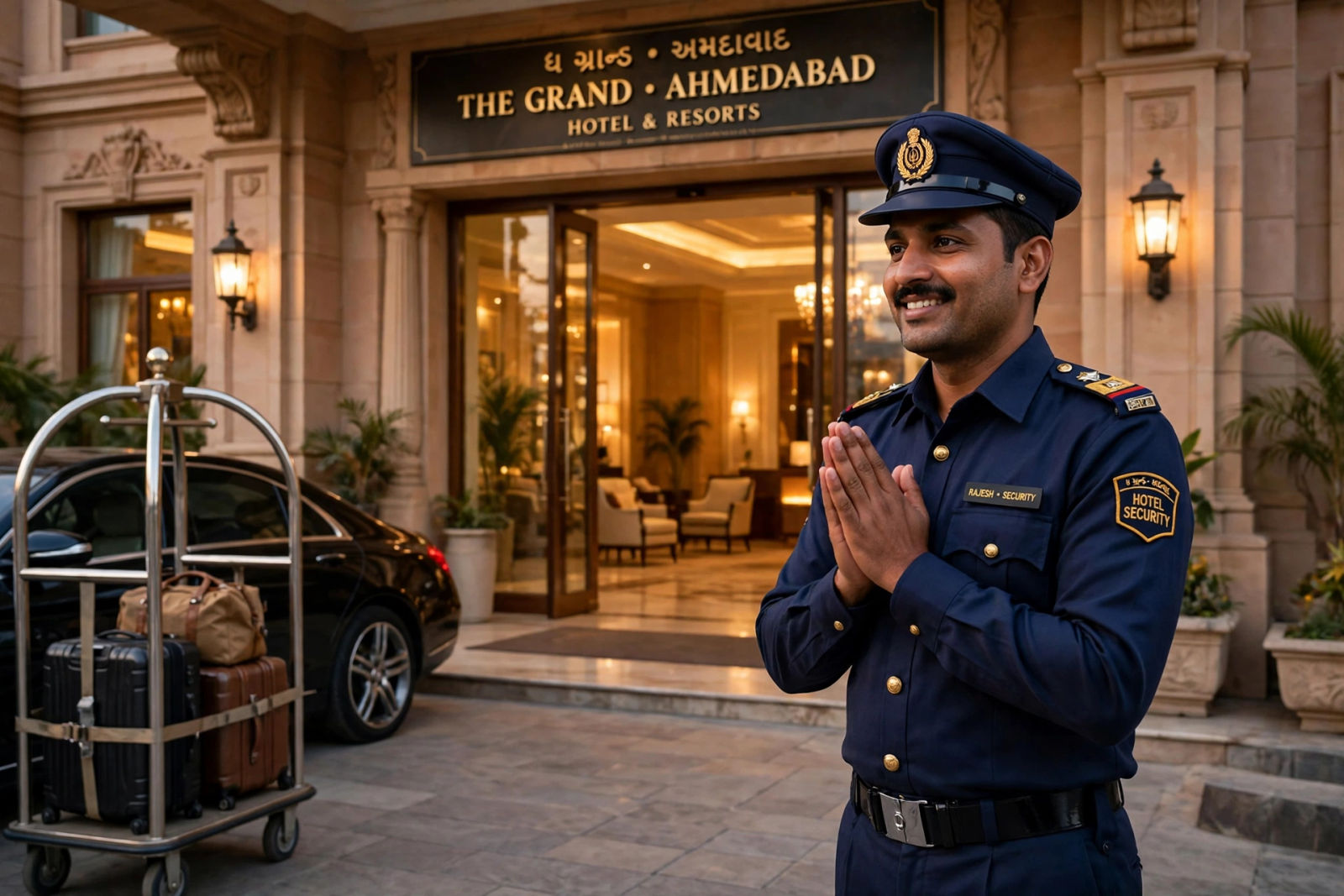
Hotel security in Gujarat explained: guest safety, fire NOC rules, front-gate checks and 7 hiring checks for hoteliers in Ahmedabad, Surat and Somnath.
- Why Hotel Security in Gujarat Is Different from Factory or Site Security
- The Front Gate Sets the Tone: Access Control Guests Accept
- Fire Safety Is the Guard's Real Job, Not a Side Duty
- Guest Safety Inside the Building: Floors, Lifts and Rooms
- Banquets, Weddings and Peak-Season Crowds
- 7 Checks Before You Hire Hotel Security Guards
- What Hotel Security Costs and How to Budget for It
- The Bottom Line for Gujarat Hoteliers
Hotel Security in Gujarat: Guest Safety, Fire Compliance and Hiring Guards That Guests Trust
Gujarat welcomed lakhs of visitors in 2025. Ahmedabad city alone recorded 2.68 crore domestic tourist visits, Ambaji 1.81 crore, Dakor 1.65 crore, Dwarka 1.42 crore and Somnath 1.13 crore, according to the Lok Sabha answer of 30 March 2026. During the nine Diwali days of 6 to 14 November 2026, more than 38 lakh people visited eight major destinations in the state. Every one of those visitors slept somewhere, and most of them slept in a hotel room they had never entered before. That is what makes hotel security different from any other kind of guarding. A hotel guard protects people who are asleep, unfamiliar with the building, and carrying cash, jewellery, laptops and passports. When the cover is right, guests never notice it. When it is wrong, the hotel finds out through a police complaint or a bad review.
Why Hotel Security in Gujarat Is Different from Factory or Site Security
A factory guard watches a gate, a boundary wall and a fixed set of workers. A hotel guard watches a building that never closes, where strangers arrive at 2 in the morning, check out at noon, and expect a smile at every door. The risks stack up in ways that surprise first-time hoteliers. Guests are asleep and cannot help themselves in an emergency. Wedding parties of 300 people share a lobby with business travellers who paid for quiet. Commercial kitchens run late, with gas banks and hot oil. Valuables sit in rooms while guests are out sightseeing in Somnath or at the Statue of Unity. Add peak seasons like Navratri, Diwali and the winter wedding months, and a 60-room hotel can feel like a small town for a weekend. The guard force has to handle all of this without making honest guests feel watched.
The Front Gate Sets the Tone: Access Control Guests Accept
The first security check a guest meets is the front gate, and it decides the mood of the whole stay. Good hotel security is firm at the gate and friendly everywhere else. Vehicles are checked at the porch, luggage is screened, and visitors are logged before they are sent to a room number. Photo ID at check-in is now standard practice in Gujarat hotels. After the 26/11 attacks in Mumbai, Ahmedabad hotels made photo ID mandatory even for Indian guests, and tightened staff verification, because the attackers had checked in as guests. The lesson still holds. Room numbers are never called out loudly at reception, key cards are issued only against ID, and duplicate keys are never handed out on a phone request. Staff entry and exit checks run through a separate gate, with bags checked on the way out. None of this needs to feel hostile. A trained guard does it with a greeting, not a glare, and guests accept it as part of a professional hotel.
Fire Safety Is the Guard's Real Job, Not a Side Duty
Fire is the single biggest danger in a hotel, because the guests are asleep and do not know the way out. Hotels in Gujarat fall under the Gujarat Fire Prevention and Life Safety Measures Act, 2013, and hotels are listed among the special buildings that need a fire safety certificate before they can operate. The point was driven home again in 2026, when a hotel fire in Delhi claimed 21 lives and the Ahmedabad Fire and Emergency Services issued notices to around 40 hotels in the city for gaps in fire safety compliance. A hotel guard is the first line of that compliance. Exits must stay clear at all hours, and no one wedges a fire door open for convenience. Alarms are tested, extinguishers are checked, and the guard on duty knows the location of every hydrant, hose reel and assembly point. Kitchen staff are watched for gas safety, and smoking in corridors is stopped before it becomes a report. Evacuation drills are rehearsed on the night shift, when the building is full and the staff is thin, because that is when a real fire will happen. The Mumbai fire brigade's report after 26/11 made the same point with 11 recommendations, including non-combustible furnishings, clear exit signage and trained fire-fighting staff in hotels. A guard who cannot run an evacuation is not a hotel guard, whatever his uniform says.
Guest Safety Inside the Building: Floors, Lifts and Rooms
Once guests are inside, the guard's job shifts from screening to quiet watching. Regular patrols cover corridors, stairwells, lift lobbies, the parking area, the pool and the gym. CCTV is monitored by someone who actually watches it, not by a guard scrolling his phone next to a wall of screens. Lifts and stairwells get special attention late at night, when most hotel incidents happen. Lady guests travelling alone deserve a clear protocol: rooms near the lift on well-lit floors, no room service entry without confirmation, and a guard available on call through the night. Lost property is logged and sealed, never pocketed, and a medical emergency gets first aid and an ambulance call within minutes, not a debate about who should call. The standard is simple. A guest should be able to walk from the lobby to the room at midnight and feel safer than on the street outside.
Banquets, Weddings and Peak-Season Crowds
Gujarat hotels earn a large share of their revenue from banquets, weddings and festival crowds, and these are the nights when security is tested hardest. A wedding with 500 guests, a DJ, a bar counter and three entry points needs a different plan from a quiet Tuesday. Entry is controlled with guest lists or wristbands, parking is directed so fire lanes stay open, and the bar area gets its own guard. During Navratri, Diwali and the pilgrim season, hotels near Somnath, Dwarka and Ambaji run near full occupancy for weeks, and the same discipline that works at temple crowds applies at the hotel gate. Pilgrim traffic also brings its own pattern, with early morning departures and late-night arrivals, so the night shift cannot be the weakest shift. The hotels that handle this well plan the cover a month ahead, add guards for the season, and brief them on the event schedule, instead of calling an agency on the morning of the function.
7 Checks Before You Hire Hotel Security Guards
PSARA licence: the agency must hold a valid licence under the Private Security Agencies (Regulation) Act, 2005. Ask to see it, and check that it covers Gujarat.
Police verification: every guard posted at your hotel must be police-verified, with documents on file. No exceptions for last-minute replacements.
Fire and first-aid training: ask for training certificates, and test the guard on the location of your extinguishers and exits on day one.
Hospitality training: a hotel guard is also the face of your property. He should be polite, presentable, and able to speak Gujarati, Hindi and basic English.
Night supervision: ask how the agency supervises the night shift. Surprise checks and a supervisor on call matter more than a daytime visit.
Written SOPs: the agency should hand you written procedures for fire, theft, medical emergencies and VIP movement, not just a promise.
Hotel references and a trial shift: speak to two other hotels the agency serves, and run a paid trial shift before signing a monthly contract.
What Hotel Security Costs and How to Budget for It
Hotel security is priced by the number of posts, the length of shifts, and the level of training, so two hotels rarely pay the same amount. A single 12-hour gate post costs less than round-the-clock cover with a supervisor, and a property in Ahmedabad pays differently from a resort near Gir. Peak season adds cost too, because wedding and festival weekends need extra guards. The mistake is to pick the cheapest quote and discover the gap during a fire drill or a theft. Budget for trained, verified guards, a supervisor who visits at night, and a written scope of work that lists every post and every duty. Get the quote in writing, with the guard count, shift timings and supervision schedule spelled out, and compare it against two other agencies on the same scope. A hotel that spends on the right cover spends far less than one that pays for a single bad night.
The Bottom Line for Gujarat Hoteliers
Hotel security in Gujarat is not about more guards at the gate. It is about the right guards, trained for fire, polite with guests, and supervised through the night. Check the PSARA licence, check the fire NOC, verify every guard, and insist on written procedures before the first guest checks in. The hotels that do this earn the trust that brings guests back, and the reviews that fill rooms in the next season. If you run a hotel in Rajkot, Ahmedabad, Surat, Somnath or Dwarka and want trained hotel security guards on your property, contact JDS Safe Guard for a site visit and a written quote.