
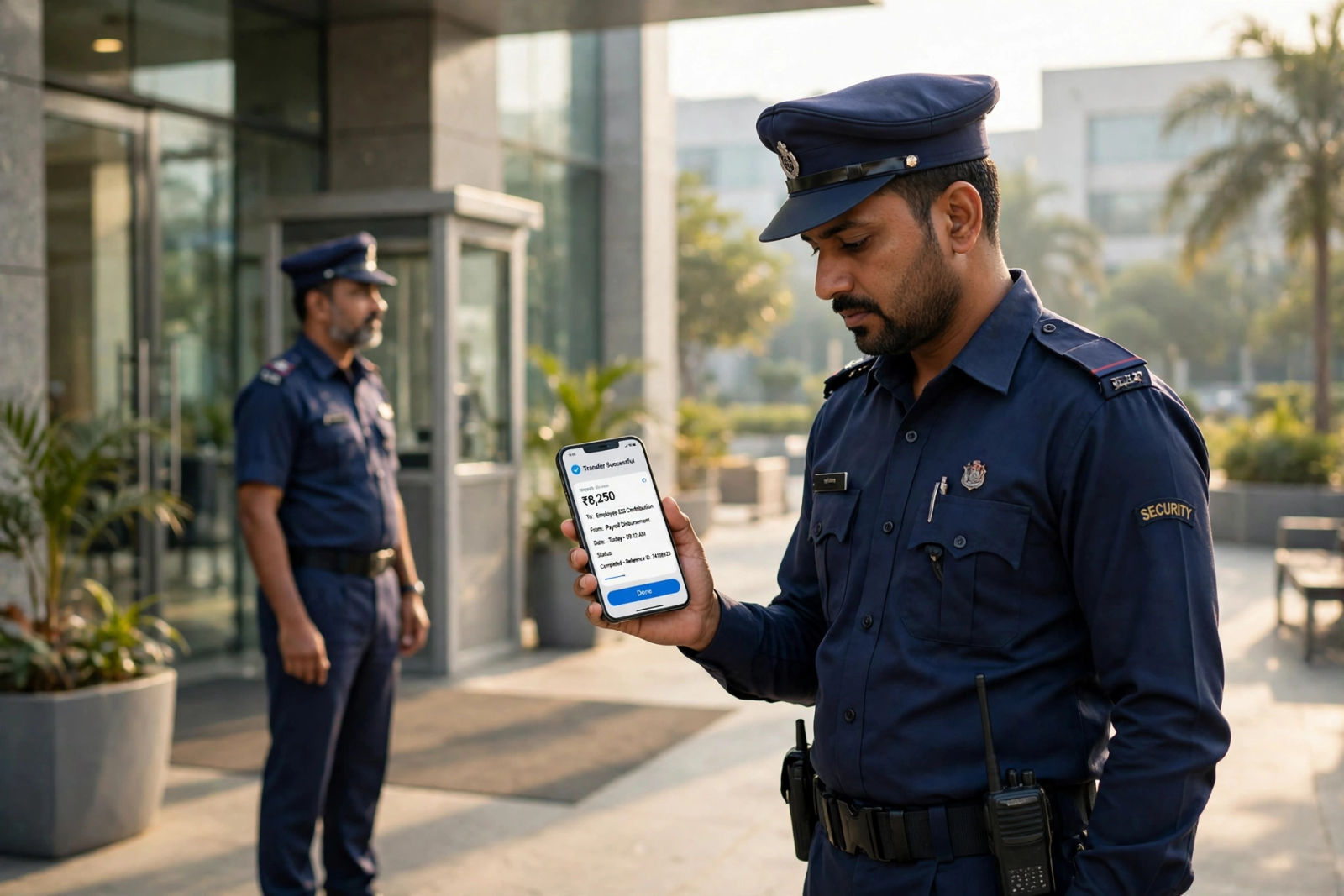
ESIC Regulations 2026: automatic sickness and maternity benefits by bank transfer, a 1% late-payment charge, and what Gujarat security guards must do now.
ESIC New Rules 2026: Sickness and Maternity Benefits Without Claim Forms, What Gujarat Security Guards Must Know
The ESIC new rules 2026 change how India's oldest health insurance scheme for workers actually pays. A guard who falls sick on duty, or a lady guard expecting a child, should not have to fight paperwork to get money the law already promises. That is the idea behind the Employees' State Insurance (General) Regulations, 2026, published in the Gazette on 21 November 2026. They replace the 1950 Regulations and move the system under the Code on Social Security, 2020. The headline for Gujarat's guards: sickness and maternity benefits will soon be paid straight into the bank account, without a claim form, if three conditions are met.
This is general information about a public notification, not legal advice. Figures and dates below come from the Gazette notification, ESIC Notification No. N-12011/1/2026-P&D dated 20 November 2026.
What changed on 21 November 2026
The Corporation notified the new Regulations on 20 November 2026, and they were published in the Gazette of India, Extraordinary, Part III, Section 4, on 21 November 2026. The timing was deliberate: the Code's savings provision kept the old ESI rules alive for one year, and that year ended on 20 November 2026. In Gujarat, ESI was extended to all 31 districts from 1 October 2026, so a guard in Rajkot, Surat, Vadodara, or a smaller town is under the same new rules.
Sickness and maternity benefits without a claim form
The change that matters most to a working guard is Regulation 29A, the "deemed claim". Under it, sickness benefit and maternity benefit will be paid to the insured person by direct benefit transfer, without a claim being made by the beneficiary. The claim is treated as raised with the Corporation the moment three conditions are all met.
First, the medical certificate must have been issued through the information system of the Corporation. A paper certificate from outside that system does not trigger the automatic route. Second, the employer must have furnished the return in Form 8B for the period, through the employers' portal. Third, the insured person must have an Aadhaar-enabled bank account, and the insurance number must be linked to Aadhaar.
When all three hold, ESIC pays the benefit straight into the bank account. If any condition is missing, the benefit is still payable, but on a claim filed in the usual way.
One point needs stating plainly, because early headlines made it sound instant. The automatic system is notified, but it is not switched on yet. Regulation 29C says the administration of claims under Regulations 29A and 29B will come into effect from a date the Director General of ESIC specifies by order. Until that date is announced, guards should keep filing claims the way they do today. What the notification does is fix the design and the conditions, so everyone can prepare now instead of scrambling later.
Injury claims: the employer report becomes the claim
Regulation 29B changes how employment injury claims work. Once ESIC accepts an injury as an employment injury, the report of the employer is treated as the claim for temporary disablement benefit, permanent disablement benefit, and dependants' benefit arising out of that injury. No separate claim is required for any of them.
Temporary disablement benefit is then paid by direct benefit transfer for each period it is payable, where the same three conditions from Regulation 29A are met. Permanent disablement benefit is paid by direct benefit transfer once the loss of earning capacity is assessed as permanent disablement by the medical board, the Medical Appeal Tribunal, or the Employees' Insurance Court. Dependants' benefit is paid by direct benefit transfer where the nomination is on record and the dependant's Aadhaar details are seeded with the bank account.
If the Branch Manager or Regional Director does not accept the injury as an employment injury, the reasons must be recorded in writing and communicated to the insured person or the dependants, who may then make a claim under Regulation 29, 65 or 70. The Regulations also say a benefit must not be withheld only because the employer failed to furnish the return or the verification by the due date. For a security agency, the lesson is direct: the accident report is no longer a piece of internal paperwork. It is the document that starts the family's benefit, and it should be filed the same day, not at the end of the month.
Faster payment deadlines, a longer maternity window
The new Regulations also put fixed clocks on ESIC itself. Regulation 37 says a benefit must be paid within a set number of days after the claim, together with the medical or other certificates and any other documents called for, has been furnished complete in all respects. The deadlines are: sickness benefit within 7 days, funeral expenses within 15 days, the first payment of maternity benefit within 14 days, the first payment of temporary disablement benefit within one month, the first payment of permanent disablement benefit within one month, and the first payment of dependants' benefit within three months.
The Regulations also lengthen the period in which maternity benefit can be claimed before delivery. Regulation 30 says a maternity benefit claim becomes due on the day eight weeks before the expected date of confinement, or on the date of issue of the certificate of expected confinement, whichever is later. That is 56 days, up from 50 days under the old position. Where the woman has two or more surviving children, the period is six weeks, or 42 days. For lady guards, who form a growing part of Gujarat's security workforce in hospitals, malls, schools, and housing societies, six extra days of paid benefit before delivery is the difference between a planned rest and a rushed one.
What employers and security agencies must do now
The new rules put three clear duties on employers, and each one is easy to get wrong if it is left to the last minute.
File the monthly Form 8B return on the employers' portal. The automatic sickness and maternity payment depends on it. An agency that files late does not stop the guard's benefit, the Regulations say so in terms, but it does block the automatic route and push the guard back to filing a claim.
Keep the register of employees in Form 4, electronically or otherwise, for every employee, and keep it for five years after it is filled.
Pay contributions on time. Regulation 22 sets damages at 1.0 per cent on the amount in arrears for every month of delay, capped at the contribution amount itself. Interest under Regulation 21 is charged separately. Damages can only be levied after the employer is given a hearing, with at least fifteen days' notice. The only waiver allowed is for an establishment covered by a resolution plan or repayment plan approved under the Insolvency and Bankruptcy Code, 2016.
One more piece of housekeeping affects payroll. The ESI wage ceiling stays at Rs 21,000 a month, now specified by Ministry of Labour and Employment Notification S.O. 6339(E) dated 20 November 2026, in force from 21 November 2026 under Chapter IV of the Code. For a person with disability, the ceiling is Rs 25,000 a month. The EPF ceiling is different: Rs 25,000 a month from 17 September 2026 under S.O. 5109(E). A guard earning Rs 23,000 a month is therefore inside PF and outside ESI.
What has not changed, and what to watch next
Three things have not changed, and saying so matters as much as the new rules. The ESI wage ceiling is the same Rs 21,000 it has been since 1 January 2017. The contribution rates have not moved: the employee pays 0.75 per cent of wages and the employer pays 3.25 per cent, and neither notification states a new rate. And the automatic payment system, the headline change, starts only on a date the ESIC Director General will specify, which has not been announced yet.
The next date to watch is that Director General order. The November 2026 changes to PF withdrawal rules, approved by the Central Board of Trustees on 19 November 2026, are also still waiting for the scheme amendment to be notified, as we explained in our post on the EPFO changes. Gujarat's minimum wages for guards, revised from 1 October 2026 with a special allowance of Rs 72.50 a day, are unaffected by the ESI changes and continue to 31 March 2027.
For a guard, the action list is short. Check that your insurance number is linked to Aadhaar, that your bank account is Aadhaar-enabled, and that your employer has your correct mobile number and nomination on record. For an employer, the list is just as short: file Form 8B on time, keep the Form 4 register current, link every guard's Aadhaar and bank details, and pay contributions before the due date so the 1 per cent monthly damages never arise.
The 1950 Regulations served for 76 years. Their replacement does not raise any rate or cut any benefit. It removes the claim form from the middle of a sick or injured worker's worst week, and it puts a clock on ESIC's own payments. That is a real improvement, as long as agencies do the small monthly jobs that make the automatic system work. If you need help checking whether your guards are enrolled correctly, contact JDS Safe Guard to discuss your security and compliance needs, or read more about our security guard services in Gujarat.
This article is general information about a public notification, not legal advice. For a decision that affects pay, benefits, or compliance, check the Gazette notification or speak to a qualified adviser.